Global Inflation Trends Diverge as UK Heats Up, US Stabilizes, and India Cools Sharply
Global Inflation Trends Diverge as UK Heats Up, US Stabilizes, and India Cools Sharply
Inflationary trends are diverging sharply across the world’s major economies, with the United Kingdom registering an unexpected uptick in consumer prices, the United States showing signs of stabilization, and India experiencing its lowest inflation in over six years.
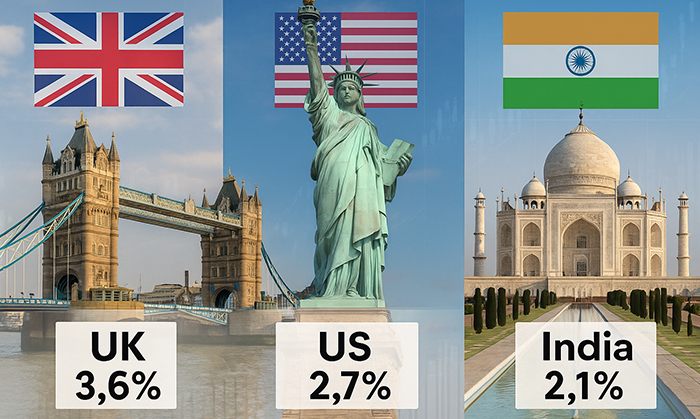
In the United Kingdom, consumer inflation rose to 3.6 percent in June, defying earlier expectations of a mild increase. Core inflation, which strips out volatile items like food and energy, also rose to 3.7 percent. The rise was driven in large part by fuel prices, which did not decline as steeply as they had during the same period last year. Food inflation also climbed for the third consecutive month, reaching its highest level since early last year, though still well below 2023 peaks. The figures highlight ongoing cost pressures for households, with policymakers acknowledging that more must be done to ease the burden on working families.
Across the Atlantic, the United States reported a 2.7 percent annual inflation rate for June, consistent with prior forecasts but marking the highest reading since February. Monthly inflation rose by 0.3 percent, while core inflation was slightly more subdued at 0.2 percent. Some price categories, such as vehicles and shelter, showed moderation. However, household goods and clothing, sectors closely linked to trade policy developments, saw notable increases. Wage growth failed to keep up, with inflation-adjusted hourly earnings dipping slightly, underscoring continued strain on consumer purchasing power.
Despite calls from political leaders for interest rate cuts to support the economy, monetary authorities have signaled a cautious approach. They remain focused on assessing the broader impact of recent trade measures and prefer to wait before adjusting policy.
Meanwhile, India stands out for its sharp decline in inflation. Consumer prices rose just 2.1 percent in June, well below earlier estimates and marking an eighth consecutive monthly drop. Food inflation turned negative, aided by strong crop production and favorable weather conditions. These factors have expanded the scope for continued monetary easing, following a recent rate cut. Officials have cited stable agricultural output as a key contributor to lower prices and increased consumer confidence. The improved inflation outlook is expected to support growth momentum, following a stronger-than-anticipated economic expansion earlier this year.
However, Indian authorities remain vigilant about potential risks, including climate variability and uncertainty surrounding global trade relations. The country is currently engaged in discussions with major trading partners to prevent the imposition of new import duties, which could affect exports and raise input costs.
Taken together, the three economies illustrate markedly different inflation trajectories. The UK faces renewed inflationary pressure, the US appears to be treading water, and India is benefiting from a rare period of price stability. For policymakers around the world, these trends underscore the challenge of navigating inflation in an environment shaped by global trade uncertainty, shifting consumer behavior, and evolving economic conditions.